Beyond
the Token
Making unpredictable hospital queues easier to understand.
A family-centered appointment experience that helps patients book, pay, and follow changing hospital queues through honest, timely status updates—without promising an exact consultation time.
- Role
- Product Designer · UX/UI Designer
- Product
- Patient mobile application
- Scope
- Research · Strategy · UX · UI
- Project
- Employment project
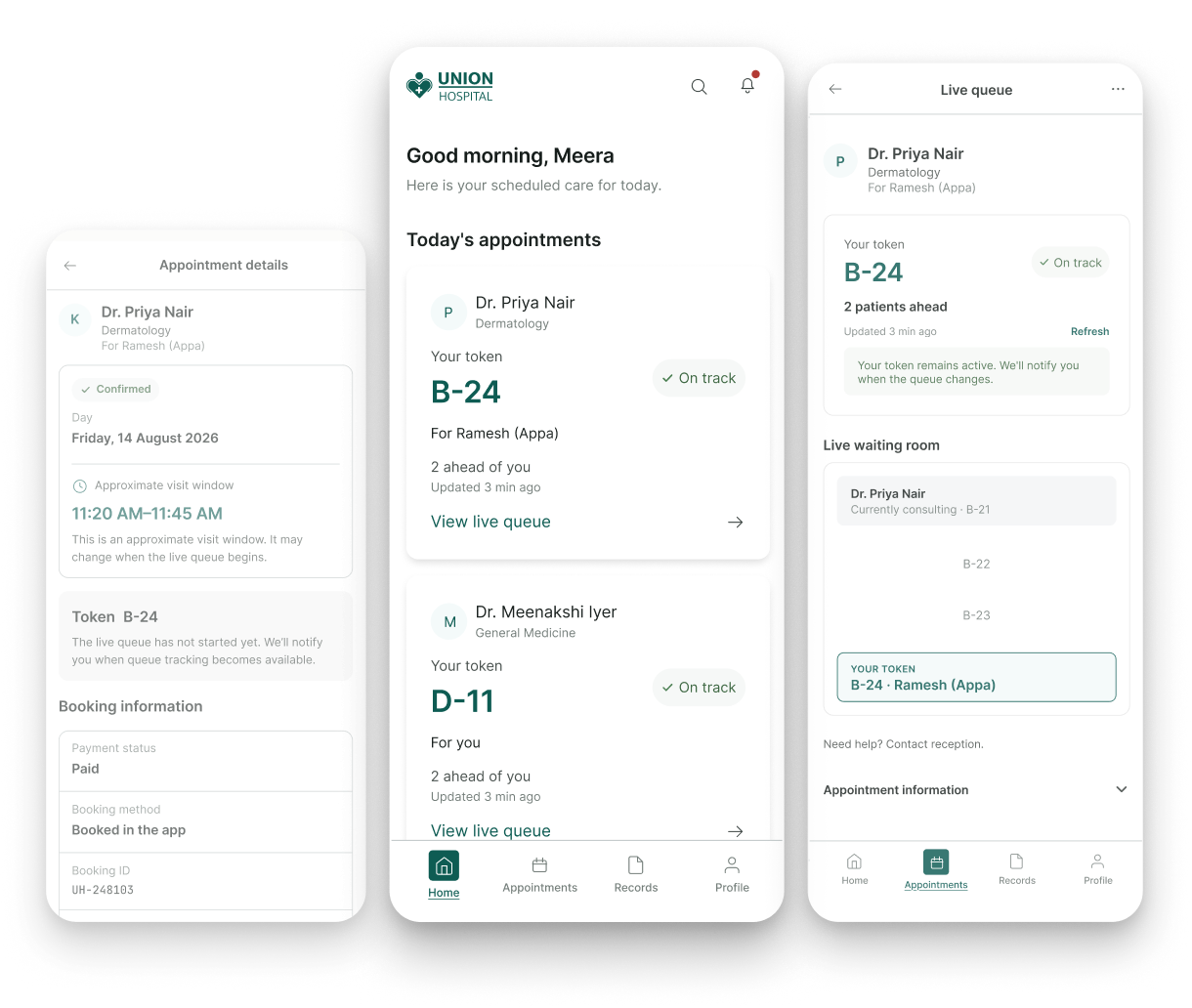
- On track
- Delayed
- Disrupted
- You're next
Project Context
A confirmed day did not mean a predictable visit.
The hospital used a token-based appointment process. A booking confirmed that a doctor was available on a particular day and issued a token, but it did not guarantee an exact consultation time. Consultation length changed with case complexity. Emergencies, no-shows, late arrivals, registration, and vitals caused the queue to drift. Patients had a place in line but very little information for planning when to travel, how long to wait, or when they would be seen.
- Doctor available
- Day confirmed
- Token issued↑ Long consultation↑ Emergency↑ No-show↑ Late arrival
- Registration & vitals
- Live queue
- Consultation

Research Approach
Understanding the experience from both sides of the queue
The research combined first-hand patient experience, observation of the hospital’s traditional token process, informal contextual conversations with patients and staff, workflow analysis, and secondary research. Conversations happened naturally in the hospital rather than as formally recruited and recorded research sessions. Names and identifiable details were not collected.
First-hand patient experience
Directly experienced
Hospital observation
Contextually observed
Patient conversations
Recurring contextual themes
Staff conversations
Recurring contextual themes
Workflow analysis
Recurring contextual themes
Secondary research
Directional market context
Research boundaries
- Conversations were informal and contextual.
- Participant identities and formal sample details were not recorded.
- Hospital operational metrics were unavailable.
- No formal usability study has yet been completed.
- Secondary-market findings remain directional.
- Findings require further validation before implementation.
Key Findings
Uncertainty—not booking itself—was the central problem.
Position ≠ timing
A token communicated position, not dependable timing.
Uncertain departure
Patients could not confidently decide when to leave home.
Silent delays
Silent delays damaged trust more than uncertainty itself.
Caregiver booking
Appointment booking extended beyond the account owner.
Staff burden
Staff absorbed queue variability through manual coordination.
The opportunity was not to create another appointment interface. It was to make an unpredictable process understandable.
Persona
Designing for the person carrying everyone’s schedule
Evidence-informed proto-persona
Synthesized from first-hand experience, contextual conversations, and observed behaviours.
Meera Krishnan
A working adult who books healthcare for herself, her child, and her father while balancing work, travel, and caregiving responsibilities.
Goals
- Know whether the hospital trip is worth making
- Secure a token before availability is exhausted
- Understand when to leave home
- Manage appointments for family members confidently
Frustrations
- A token number provides little timing information
- Delays are often communicated only after waiting begins
- Every visit consumes an unpredictable part of the day
- Family appointments multiply the uncertainty
Empathy map
Thinks
- Is the doctor really available?
- Will a token still be available?
- When should we leave?
- How much of the day will this take?
Feels
- Uncertain
- Time-pressured
- Responsible for others
- Frustrated by silence
Does
- Calls ahead
- Arrives early
- Over-buffers time
- Books for relatives
- Watches queue informally
Needs
- Trustworthy availability
- Clear confirmation
- Honest queue status
- Persistent family context
- Clear recovery when plans change
Customer Journey
The most difficult moment came after the token was secured.
Receiving a token solved access to the doctor, but it did not solve the patient’s need to plan. The greatest uncertainty appeared between securing the token and entering the consultation.
Scenario
Meera is arranging a follow-up consultation for her father while balancing work, travel, and caregiving responsibilities.
Goal
Secure access to the doctor and make an informed decision about when to travel.
Swipe horizontally to explore all seven stages →
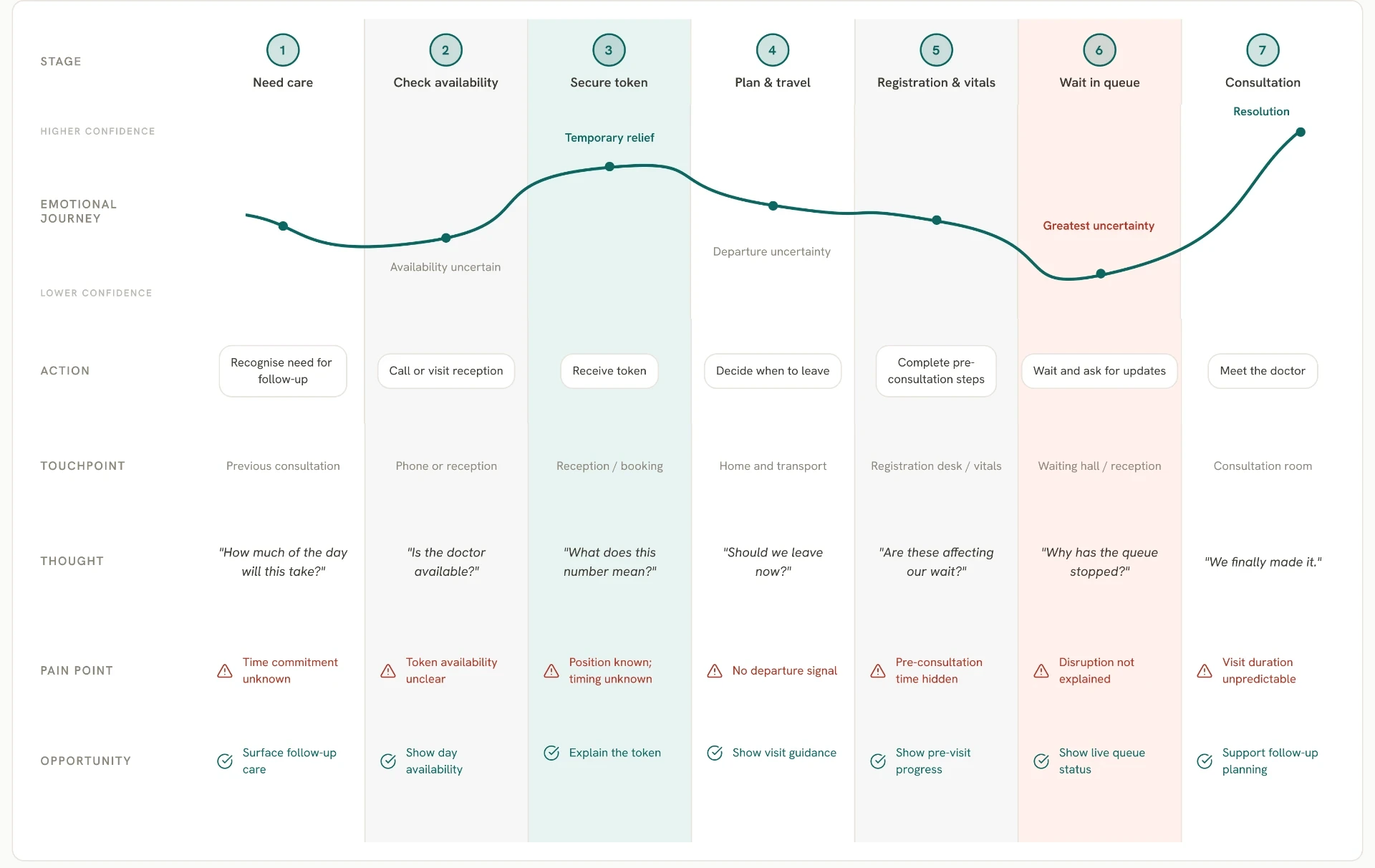
- Stage 1: Need care. Action: Recognise need for follow-up. Touchpoint: Previous consultation. Thought: “How much of the day will this take?”. Pain point: Time commitment unknown. Opportunity: Surface follow-up care.
- Stage 2: Check availability. Action: Call or visit reception. Touchpoint: Phone or reception. Thought: “Is the doctor available?”. Pain point: Token availability unclear. Opportunity: Show day availability.
- Stage 3: Secure token. Action: Receive token. Touchpoint: Reception / booking. Thought: “What does this number mean?”. Pain point: Position known; timing unknown. Opportunity: Explain the token.
- Stage 4: Plan & travel. Action: Decide when to leave. Touchpoint: Home and transport. Thought: “Should we leave now?”. Pain point: No departure signal. Opportunity: Show visit guidance.
- Stage 5: Registration & vitals. Action: Complete pre-consultation steps. Touchpoint: Registration desk / vitals. Thought: “Are these affecting our wait?”. Pain point: Pre-consultation time hidden. Opportunity: Show pre-visit progress.
- Stage 6: Wait in queue. Action: Wait and ask for updates. Touchpoint: Waiting hall / reception. Thought: “Why has the queue stopped?”. Pain point: Disruption not explained. Opportunity: Show live queue status.
- Stage 7: Consultation. Action: Meet the doctor. Touchpoint: Consultation room. Thought: “We finally made it.”. Pain point: Visit duration unpredictable. Opportunity: Support follow-up planning.
Before the visit
Show truthful availability before the patient travels.
During the visit
Explain the token and communicate real queue progress.
When reality changes
Replace silence with delayed, disrupted, and actionable status.
Staff activity
- Check availability
- Confirm availability
- Issue token
- Prepare patient record
- Register & vitals
- Track queue & disruption
- Call next patient
Patient uncertainty increases when staff activity changes but no information reaches the patient.
Core Insight
The product should not promise false precision.
“The product’s job is not to guarantee a consultation time the hospital cannot control. Its job is to make the token’s meaning understandable and keep patients honestly informed as the real queue changes.”
Problem statement
Patients and caregivers need a dependable way to book and track hospital appointments because token-based queues change throughout the day, making visits difficult to plan and forcing staff to communicate disruptions manually.
How Might We
How might we help patients make informed decisions around a changing hospital queue without creating false confidence in an exact consultation time?
Design principles
Communicate honestly
Status over false precision
Preserve patient context
Know who the appointment is for
Design for family care
Caregiving is a core workflow
Provide clear recovery
When circumstances change
Status, not promises
Honest queue information
Information Architecture
A familiar structure with booking available in context
The final application uses four persistent destinations. Booking begins contextually from Home or Appointments, allowing the navigation to remain focused on ongoing care.
Booking is treated as a contextual task rather than a permanent navigation destination.
End-to-End User Flow
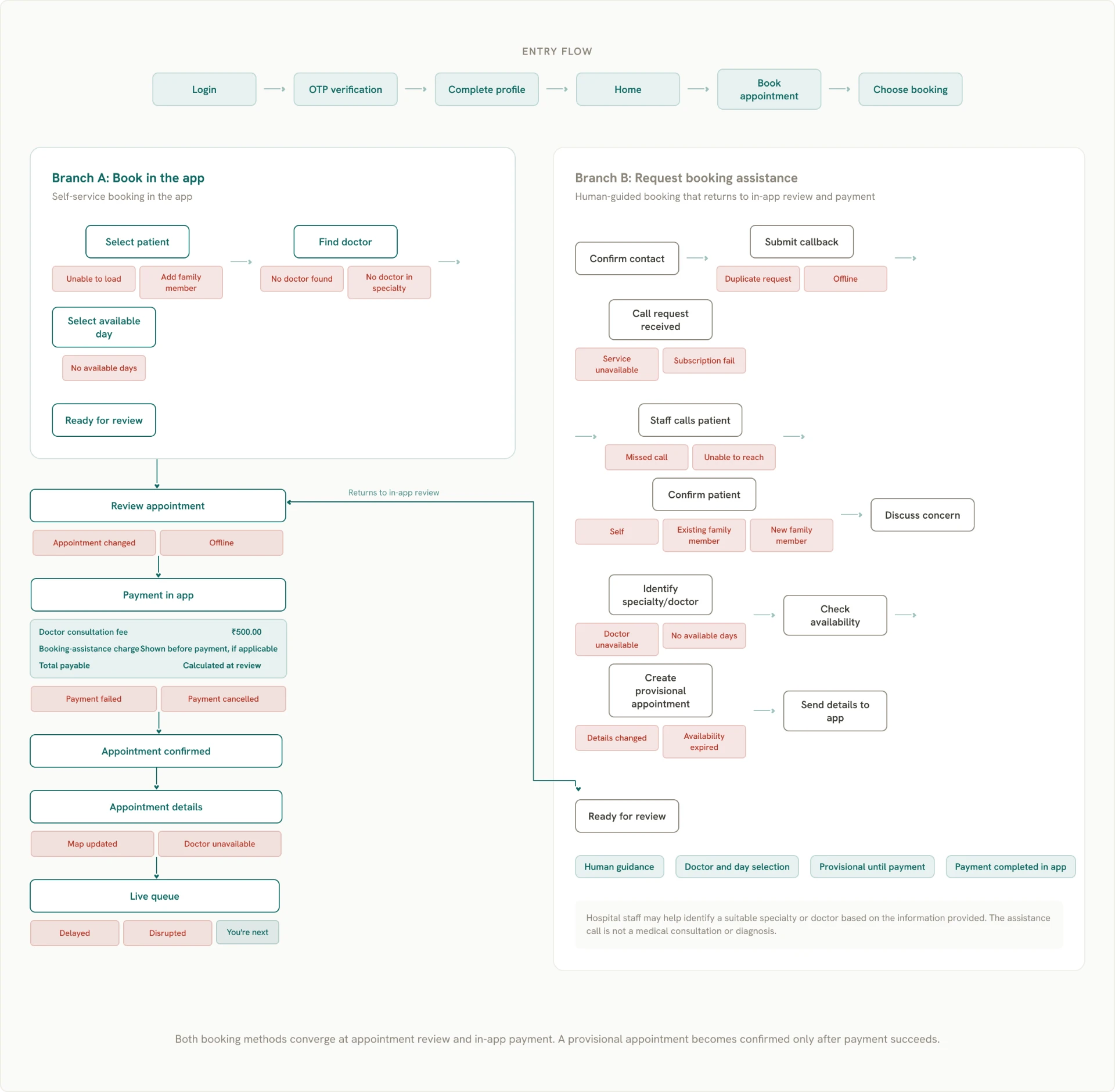
Two ways to complete the same healthcare goal
Patients can book independently or request guidance from the hospital team. Both paths converge at appointment review and in-app payment. An appointment is confirmed only after payment succeeds.
Task Flows
Focusing on the moments that carry the most risk
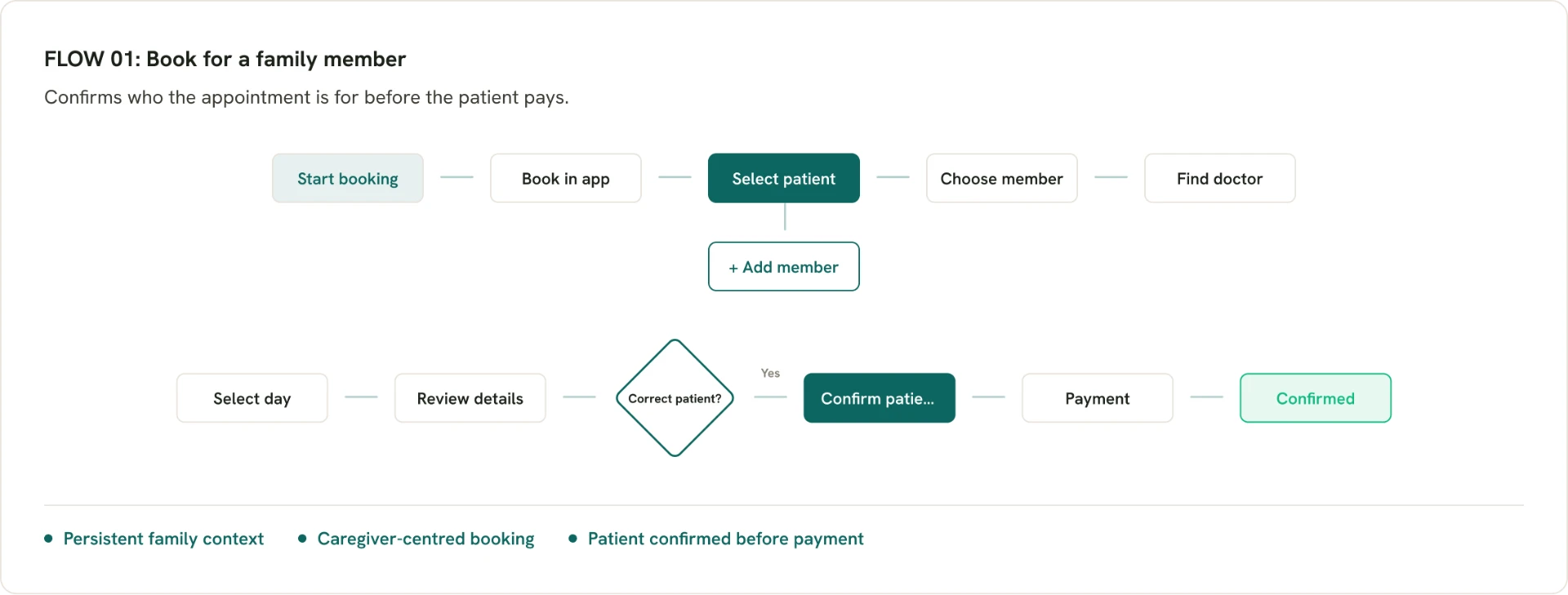
I mapped the three paths where a mistake costs the patient most: booking for someone else, following a changing queue, and recovering from an uncertain payment.
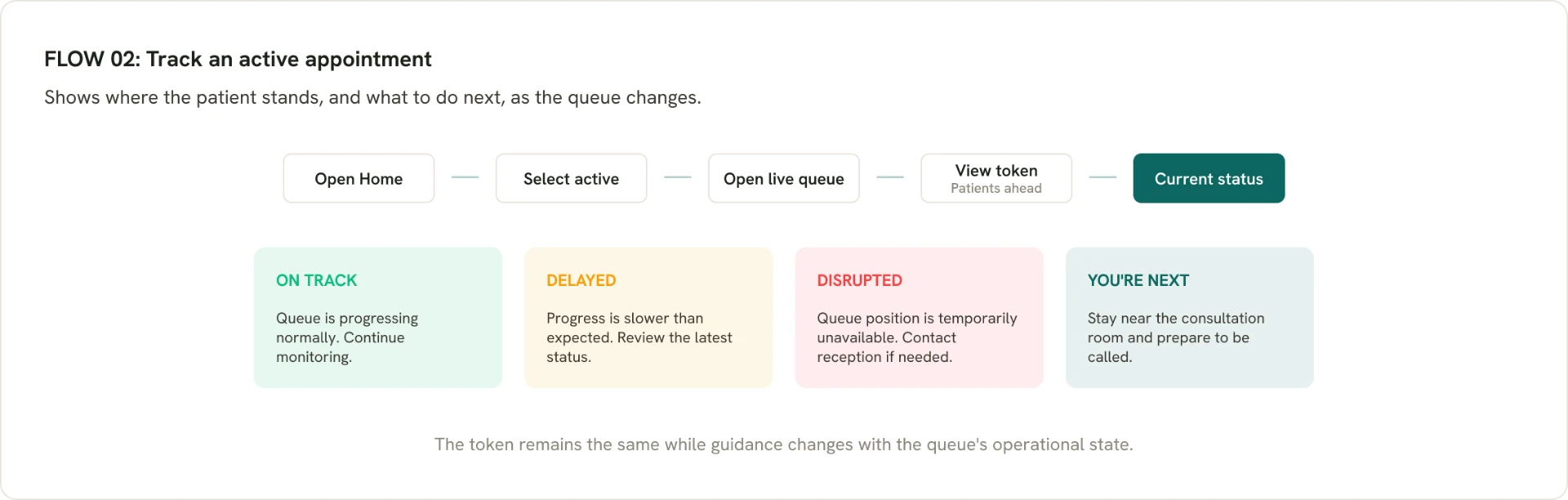
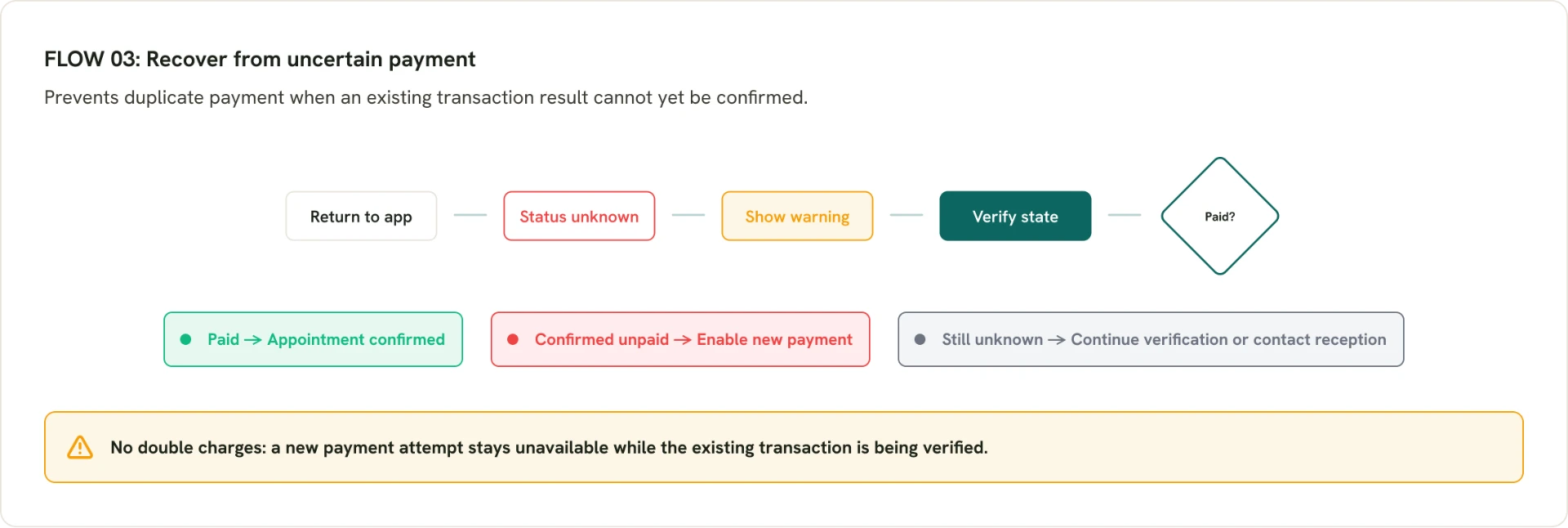
Final Solution
From booking to the waiting room
Fast, low-friction access
Mobile-number authentication and OTP verification reduce account friction while still providing complete validation, loading, incorrect-code, and expired-code recovery.
Swipe to explore the complete flow →
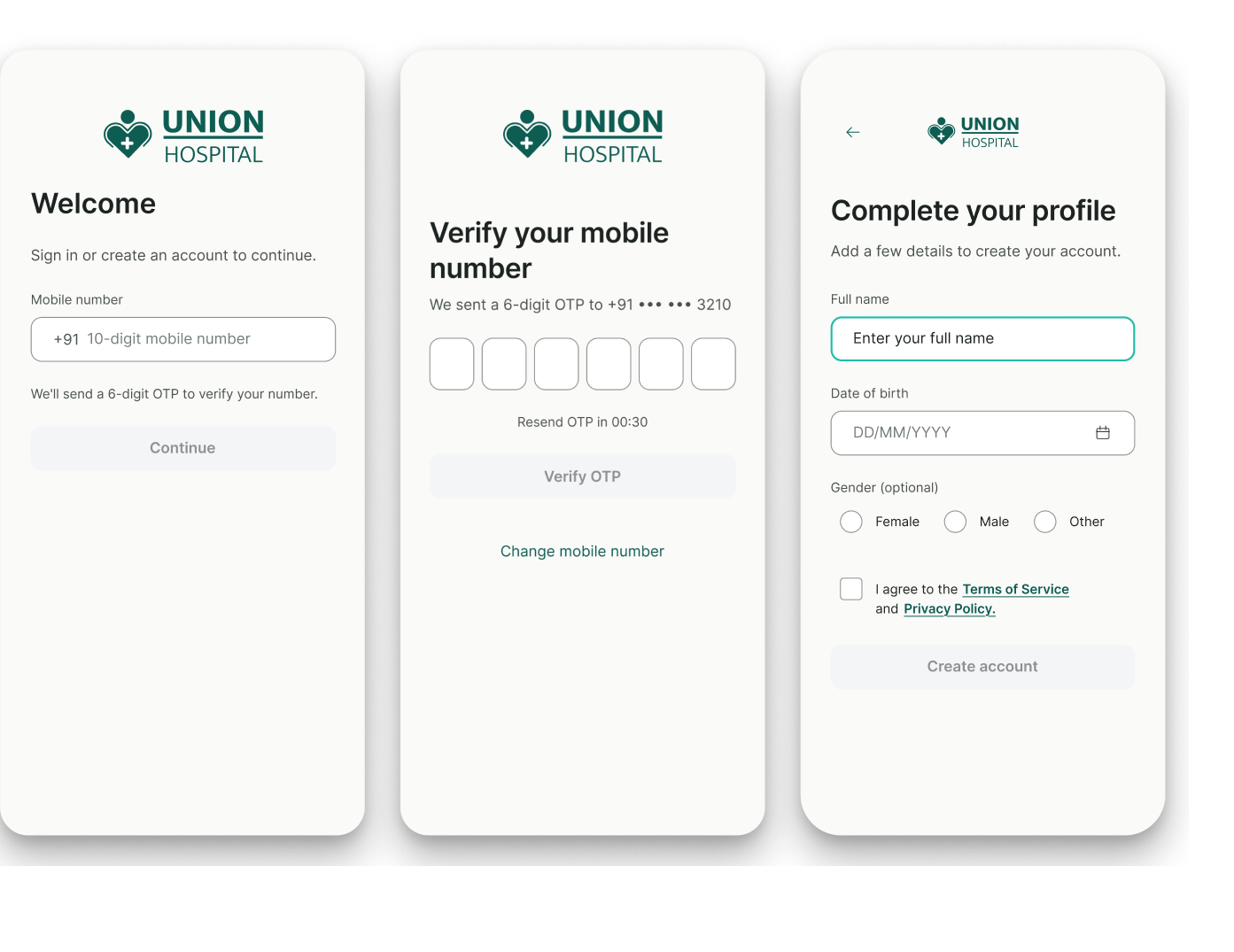
- Mobile number authentication
- 6-digit OTP verification
- Complete profile on first sign-in
- Validation and recovery at every step
Booking for the right person
Patient identity remains visible throughout the booking flow. People can book for themselves, choose an existing family member, or add someone without losing their progress.
Swipe to explore the complete flow →
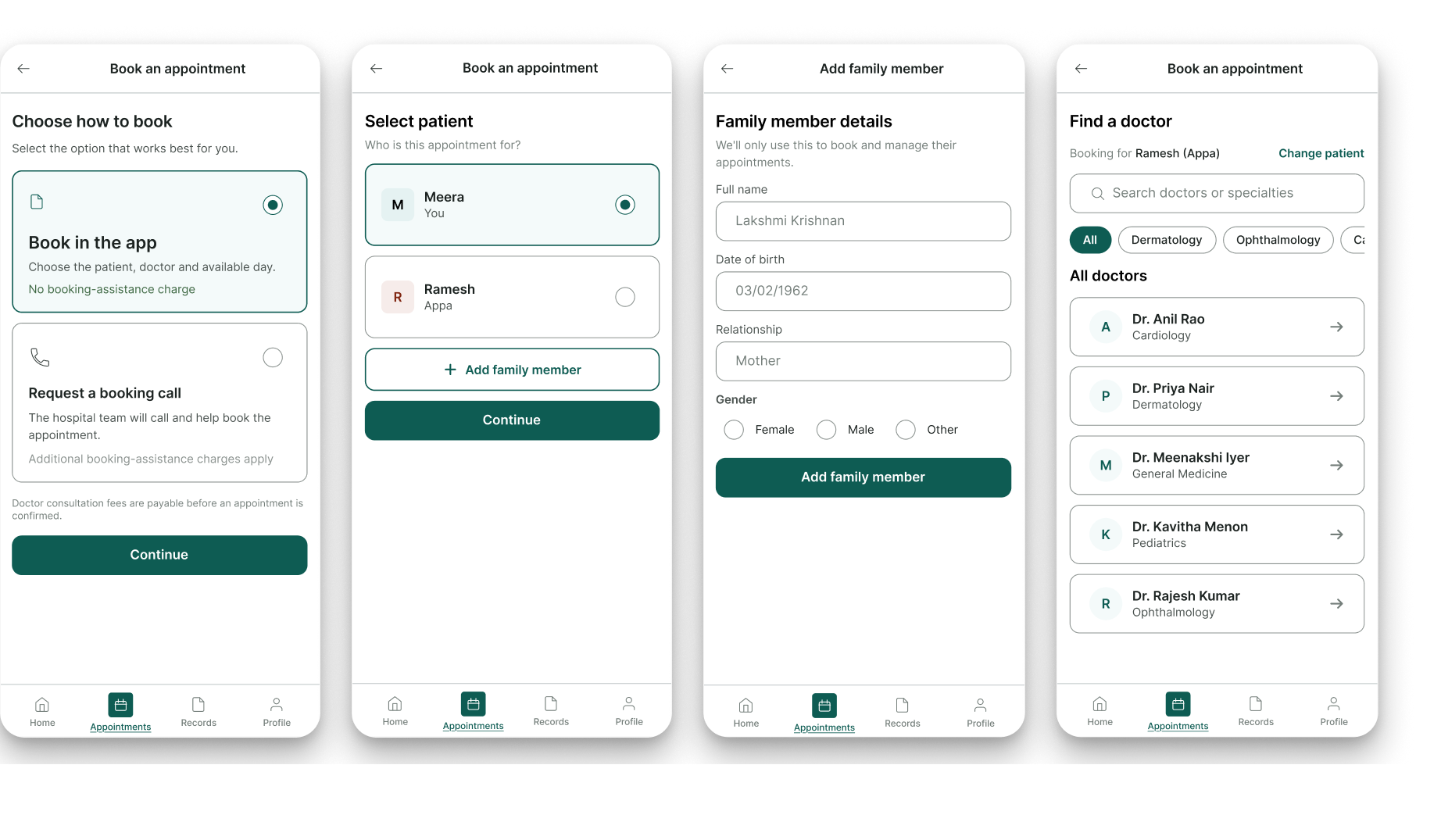
- Self-service or assisted booking
- Persistent patient context
- Family care as a core workflow
- Search and specialty filtering
Review before committing
Patients review the person, doctor, day, booking method, and approximate consultation window before payment. The interface explains that the window is an early estimate that may change when the live queue begins.
Swipe to explore the complete flow →
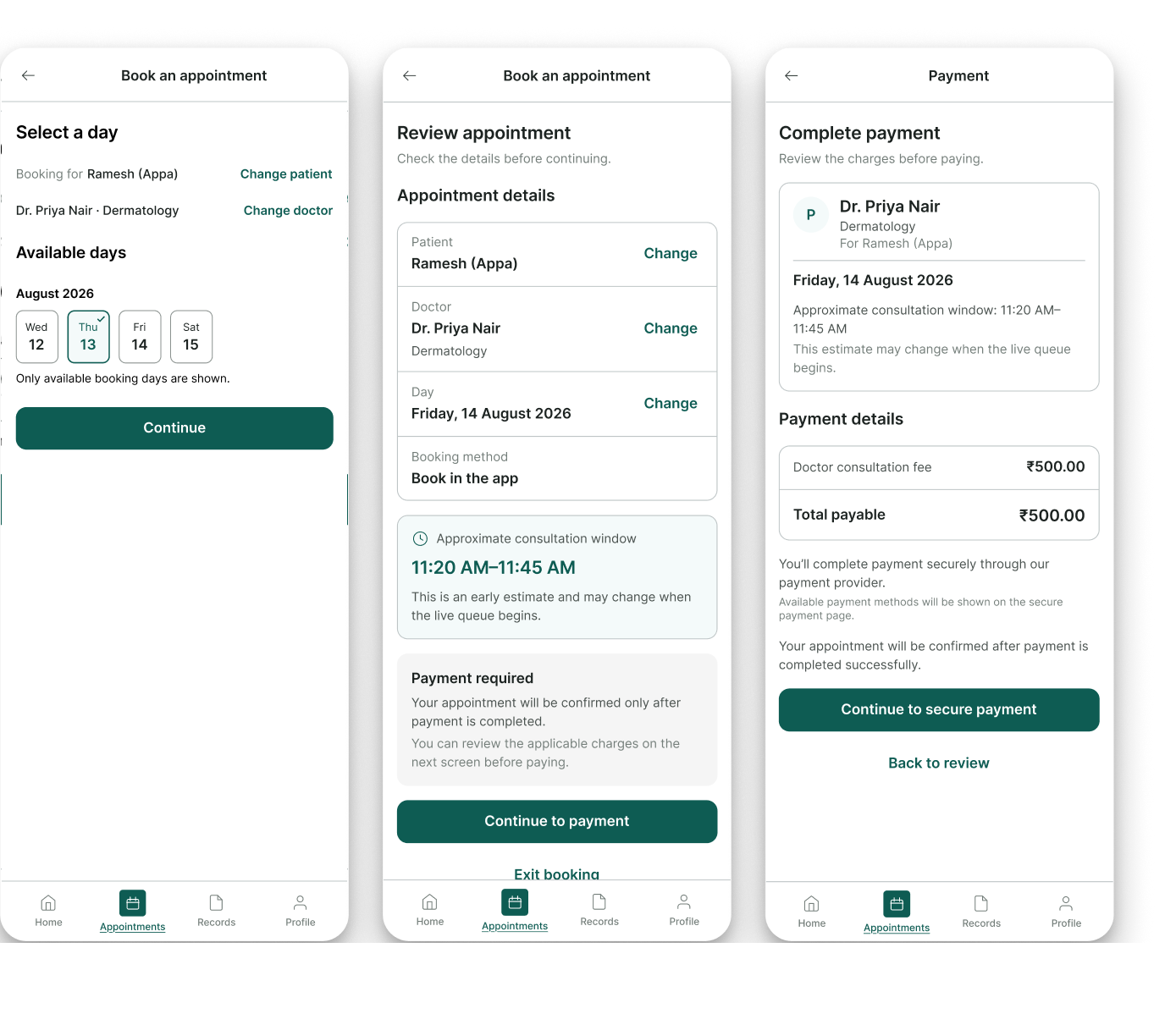
- Available days instead of false time-slot precision
- Editable appointment details
- Transparent payment requirement
- Qualified approximate visit window
Safe recovery when reality changes
Healthcare booking involves uncertainty. The experience provides clear recovery when availability changes, payment fails, connectivity is lost, the hospital updates an appointment, or the doctor becomes unavailable.
Swipe to explore the complete flow →
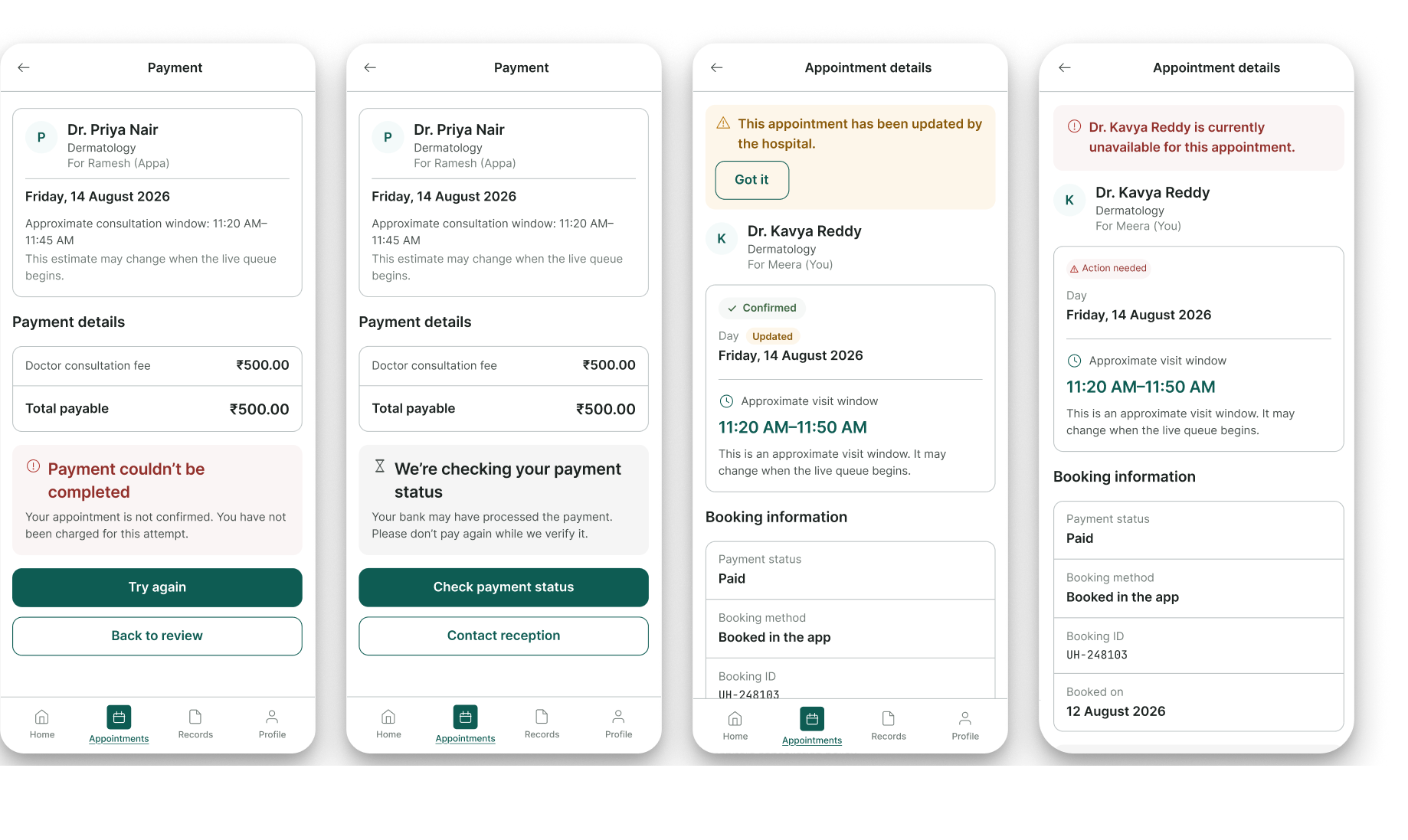
- Payment failed — clear next step
- Payment unknown — do not pay again
- Hospital-updated appointment notification
- Doctor unavailable with contact options
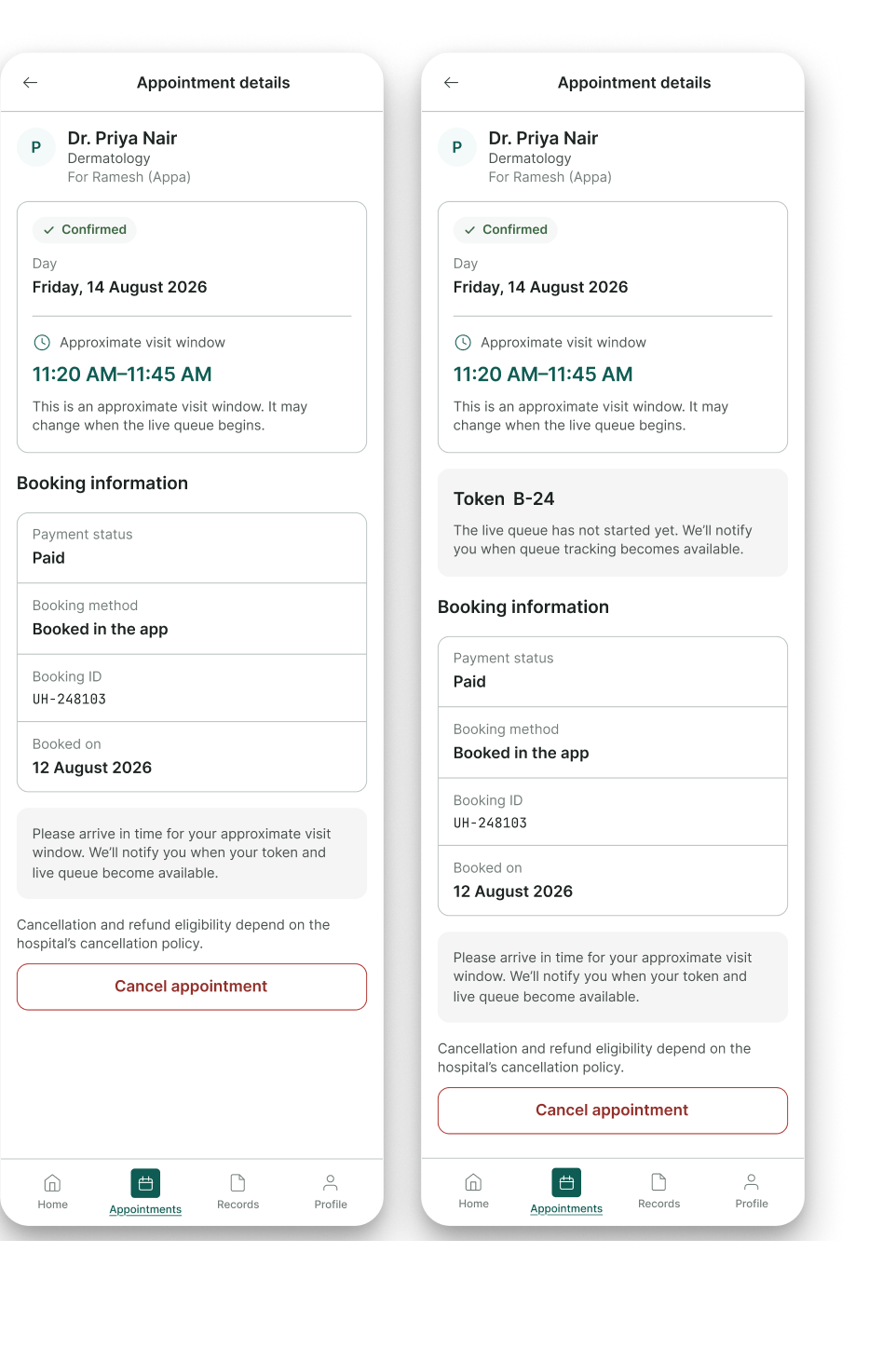
Appointment confirmed
Once payment is verified, the provisional appointment becomes confirmed. The patient receives a dependable reference point containing the doctor, patient, booking date, payment status, approximate visit window and token information.
- Confirmed appointment details
- Payment status clearly recorded
- Token issued before the visit day
- Direct access to appointment details and live queue
Confirmation only after payment
The appointment remains provisional until successful payment is verified.
A dependable reference
Doctor, patient, payment and booking information remain available from one appointment record.
Ready for the live queue
The confirmed appointment becomes the entry point to queue tracking when the visit approaches.
Swipe to explore the complete flow →
Live Queue
A queue patients can finally understand
The live queue replaces silent waiting with visible, actionable status. It communicates what is happening without pretending the system can guarantee an exact consultation time.
Swipe to see how the queue status changes →
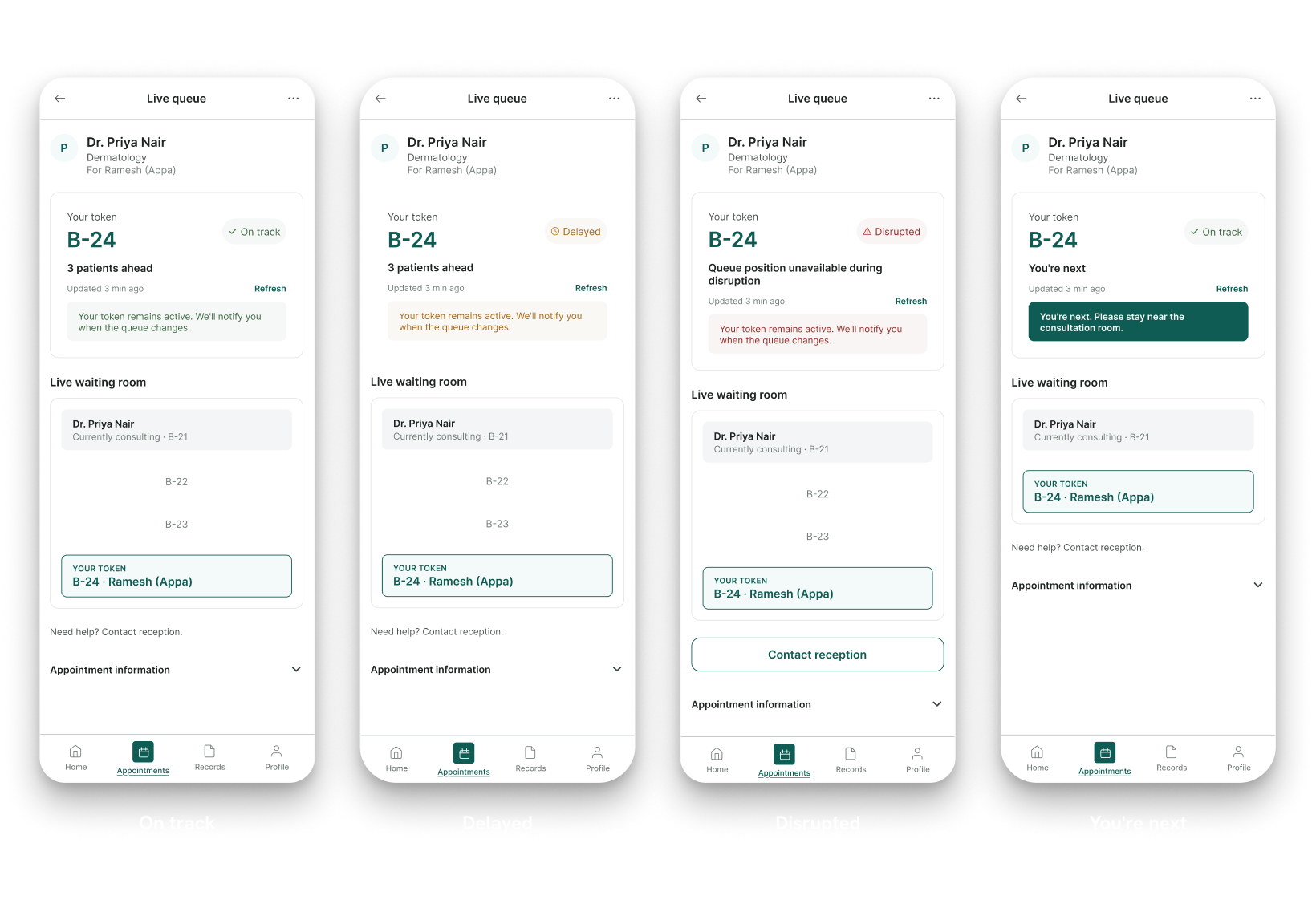
- On track: Shows the token, patients ahead, and the latest update.
- Delayed: Explains that progress is slower than expected.
- Disrupted: Makes an interruption visible and provides access to help.
- You're next: Changes from passive tracking to clear arrival guidance.
The token stayed the same. The information around it became useful.
Edge Cases
Designed for the moments that break trust
Input
- Validation
- Incorrect OTP
- Expired OTP
Connectivity
- Loading
- Offline
- Unable to load
Availability
- No doctors
- No available days
- Availability changed
Payment
- Redirecting
- Failed
- Cancelled
- Unknown
- Session expired
Hospital operations
- Appointment changed
- Doctor unavailable
- Queue delayed
- Queue disrupted
Assisted booking
- Duplicate request
- Service unavailable
- Status verification
Finding → Design traceability
Token provides little timing information
leads toLive queue and patients-ahead status
Patients cannot plan when to travel
leads toApproximate consultation window + queue state
Silent disruption damages trust
leads toDelayed, disrupted, and unavailable states
People book for relatives
leads toPatient selection and persistent family context
Some users want human assistance
leads toRequest-a-booking-call route
Payment outcomes can be unclear
leads toStatus verification and duplicate-payment prevention
Accessibility & Reflection
Clarity matters most when people are already under pressure.
Accessibility considerations
- Status is communicated through text as well as color.
- Actions use clear, plain-language labels.
- Touch targets are designed for comfortable mobile use.
- Loading and validation states remain visible.
- Personal information is masked where appropriate.
- Payment recovery prevents harmful repetition.
- Motion should respect reduced-motion preferences.
What I would validate next
- 1.Test token and approximate-window comprehension.
- 2.Test family-member booking with patients and caregivers.
- 3.Evaluate delayed and disrupted queue messaging.
- 4.Test payment recovery under uncertain status.
- 5.Review operational feasibility with front-desk staff.
- 6.Conduct accessibility and poor-connectivity testing.
Proposed measures
- Booking completion
- Abandonment rate
- Incorrect-patient bookings
- Queue-update calls
- Duplicate-payment risk
- Token comprehension
- Departure confidence
What this project changed in my thinking
I began with the idea of simplifying appointment booking. The research revealed a more important challenge: booking was only the beginning of the uncertainty.
The strongest design decision was not to manufacture an exact time. It was to communicate what the system genuinely knew—who the appointment was for, whether it was confirmed, how the queue was progressing, and what the patient should do when circumstances changed. The project also showed that patient and staff experiences cannot be separated.
Good healthcare communication does not remove uncertainty. It makes uncertainty understandable and actionable.